Sunday, 21 November 2010

Season 4: Already Underway!

Hello all!

Well, I kinda abandoned last season's blog, as long-term readers know. Suffice it to say, all turned out well and mission accomplished. I may go back on one of these posts and put up a few pics and links.

But in the meantime, I am back at Halley now and will bring you up to speed on the current season. Fair warning - I will probably blog less this year; perhaps once every ten days. But this season could be the most interesting yet, as I have work all over our half of Antarctica and don't quite know when or how I'm getting home.

So let's begin.

My season this year started on November 4. After a charming weekend in Oxford and the Cotswolds, where we stayed in a 500-year old pub in Shipton-under-Wychwood, Rachel dropped me off at Heathrow for the Cape Town flight.

I've come into Halley three times in the past - twice through Rothera and Chile, and once via ship from Cape Town. This time it was by air, via Cape Town. As usual, though, we had a bit of a buffer between our arrival and our departure, so there was time to frolic in Cape Town. We were put up in a hostel-like place near the V&A Waterfront - the swish area full of expensive shops and whatnot. Our place was fairly bare bones, but had a good location. So no complaints.

As I'm now a veteran of Cape Town, once again I played a minor role as tour guide/town expert. I knew the best place for pizza ("Clay Oven", Long Road), the various routes up Table Mountain, and where to get the best banana colada (some place in Camp's Bay; can't recall the name).

However, this time, I went with an armada of chefs - we've got seven this year (this includes a few who aren't actively chef-ing; some have changed roles). They made a few new discoveries that have gone in my file folder. Or would, if I had such items of organization.

Usual pictures of Cape Town. Camp's Bay:

...and the obligatory climb up Table Mountain:

While wandering downtown, this newspaper front made me laugh:

Seriously, I've only got one suggestion for you and your old vuvuzela.

Anyway, it was about three days of exploring before we got the go-ahead. We left Cape Town at 11:30pm, for the 5 hour flight to Antarctica. I have to say, I'm not particularly a fan of this particular flight. It's a Russian plane, whose toilet is a ratchet-strapped portapotty, and is ridiculously hot. Fortunately, I had my iPad with Civilizations on it to keep me occupied. Sleep was sadly not an option.

But then we were there! Novolazarevskeya, the Russian base. Last time I came through there, in 2008, we were there for about 45 minutes. This time, it was three days.

First thing we did was unload the plane. This wasn't trivial. Five different bases were serviced by this flight. And, in addition, there was some equipment for a race to the pole! I've seen signs of this here and there - keep an eye out in the news for it. As it was, we were carrying down one of the vehicles:

I was lucky enough to get a ride in one of these vehicles up to base from the skiway - about 15km. I can safely say it was the coolest way to traverse a glacier. Fast.

As it turns out, it was a good thing these things were around the base. While I was there, some guy - a Canadian, no less - went out for a walk and fell straight into a crevasse. Just opened up right underneath him! He was a tourist and stuck down there for five hours. When they tracked him down, they tried getting him out by the usual mountaineering pulleys, but no luck. So they drove one of these vehicles up and winched him out.

However, I was oblivious to all this. We were staying in an area of the Russian base called the Oasis. The accommodations were a little bit, shall we say, tight:


Fortunately, it was only one night of this before we were upgraded. The best feature of Novoa and the Oasis, though, was the sauna/health club. It was set up by one of the Russian long-timers and polar heroes, Vladimir Baranov. He still runs it. I think he has a base named after him somewhere. But his passion is now the sauna. He and his daughter, a doctor, run the Oasis. Here he is, presenting a certificate to some of the sauna attendees.

I was to receive mine later that night.

Here we are taking a stroll of our own. We were knowledgeable enough to avoid obvious crevasse areas.

After day three, we had word there was a weather window at Halley, so we went for it. My travel back to the skiway was in a bit more traditional Russian conveyance:
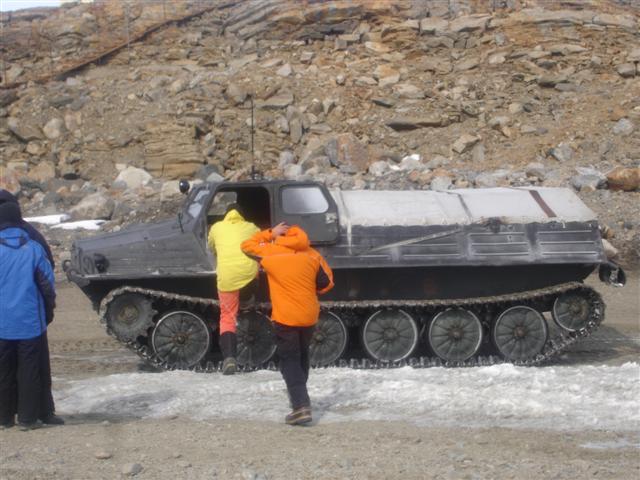
And no, this thing wasn't exactly whisper-quiet.

Anyway! We got to the plane, and with minimal fanfare, we were on our way to Halley. But alas - our window had closed. We were half an hour away from Halley when we had to reroute to a different base, SANAE.

And I shall leave you here, for the moment. I need to convert a few more pictures from SANAE, which has been one of the oddest places I've been on the planet. And besides, it's 8pm - past my bedtime! I'm trying to keep very early hours this season, getting up at 4:45am and asleep by 8:30pm. This schedule usually has a half-life of one week. All it takes is one big party and I'm sleeping into 8am and there's no turning back.

Night!

Tuesday, 26 January 2010

Sky-Blu: The Great Wait

Right. I believe I left off my last entry arriving into Rothera, on December 30. This, obviously, got me there in time for New Year's celebrations, which was a party in the garage, which was transformed into a pub for the evening:

It was a costume party...I didn't get one together in time, though. And I also left the camera behind, so I couldn't capture the evening on film (so to speak). But suffice it to say that we heralded in the new decade with much aplomb.

Personally, it was a time of reflection for me - ten years ago, I was just finishing off undergrad, and dancing on top of a speaker at a charming bar in Waterloo named Philthy McNasty's. When the fated New Year's moment rolled around, a fellow patron apparently took exception to my presence there (I have no idea why) and started pushing me. I didn't notice - not being all that observant, and it was loud - and just as this fellow was giving up in disgust, one of my party (Tara, if you read this blog, I'm looking in your general direction!) threw a drink at them. Thinking I threw the drink, the fellow was about to engage in fisticuffs. I defused the situation adroitly by doing what I do best - smiling politely and looking confused, until the bouncers came and ejected the fine gentleman. Who, subsequently, will have to spend the rest of his life telling people that he ushered in the new millennium in an unceremonious parking lot, allegedly because of some jackass on a speaker.

Anyway, got sidetracked there. Just wanted to point out that the young fellow on the speaker probably wouldn't have predicted that his 10-year-in-the-future self would have been in Antarctica exactly ten years later. With significantly less money and possessions than intended (I wanted to be rich - it was the end of the dot-com era) - but definitely with a lot more life experience than was in the original plan. And more hair.

Ok, bringing it back to Rothera. New Year's Day was relatively quiet; Rothera parties hard and sleeps in on the next day, more than Halley. But I got the call to be ready on Jan 2 for transfer to Sky-Blu. And thus began the wait. The wait for a weather window to get to the Evans Ice Stream, where my work awaited me.

So here's where I waited. Ladies and gentlemen, welcome to Sky-Blu.


Sky-Blu is a way station; the place at the base of the Antarctic peninsula from where BAS launches its deep field activities. It is summer only - it is opened in late November, and closed up again in February. It is the southern terminus for the Dash; it has an ice runway that can handle wheeled aircraft, so massive amounts of equipment and fuel can be sent here more economically than one could in Twin Otters.

A posting at Sky-Blu is dreaded by some, and coveted by others. Work duties are fairly simple - you are constantly loading and unloading fuel from airplanes, keeping the machinery working, and usually either opening or closing the station, which takes about a month each. I happened to arrive at the apex of the summer, so duties were mostly restricted to fuel and snow. But mainly, I was working on domestics.


This big red thing is the "Melon hut", presumably named for its watermelon-esque shape. Inside is our social/radio/cooking room - basically, everything except sleeping and toilets, which are done in tents. I usually hovered around the hut, keeping our meltwater supplies up, doing dishes, and so on, unless a plane was coming in.

Here's where I slept; in a pretty comfy weather haven. We got a paraffin stove running while I was there, but it was a bit gutless. Weather was, in general, -10C the whole time I was there - the stove would "take the edge off", as we coyly put it, bringing the temperature up to 0C-ish.

Although really, the stove had much less impact than the sun and wind. If it was cloudy and blowy, we slept in -10C. If it was sunny and still all through the night, temperature would easily rocket up to +10C. Which made our warm sleeping bags unbearable.

And so my days came and went. And pilots came and went, too. The Evans Ice Stream remained shrouded in clouds for almost a week. I would get up in the morning, go to the Melon hut, and wait for the morning HF radio chat with Rothera. The pilots would outline what planes would be where, who'd be coming to Sky-Blu; and, as an afterthought, yes, the Evans is still unreachable. And then I would grumble and wander out of the hut, feeling like...


However, that was just work anxiety. Sky-Blu does have somewhat of a therapeutic appeal. It's certainly the longest I've been without Internet since 1996. The food situation was interesting; when I first arrived, it was just four of us guys there and we didn't make much effort. Kat, our mountaineer which eventually came to the Evans with me, arrived partway through and began cooking with a bit more effort. She even set up the solar oven and made bread and pizza:

And so the days rolled by. One day, we climbed a local nunatak (this is a mountain/hilltop that pokes out through the deep glacier). It was certainly a stunning view.

For some reason, a whole lotta nothing looks more impressive with some altitude.

Then, on Jan 9, a patch opened up on the Evans. Steve King was in the area, doing fuel runs, with the Rothera doctor, Matt Doc, as co-pilot. All the pieces were there...and Sledge X-Ray was ready to go. (That was our callsign.)

Stay tuned to the next blog for Sledge X-Ray's adventures. In the meantime, I offer penguin pics for your consideration.


Thursday, 21 January 2010

From Halley to Rothera

Apologies to all for the extended absence. I've been everywhere under the sun since I last put in an entry, and I'm writing on a flight north out of Antarctica, back to Punta [and posting it a week later]. I shall make three more entries, say, after this one, as I slowly catch up on all my doings. So let's start by going back to the end of December. At Halley.

I believe when we last left off, I was waiting for relief to begin. Well, it never did begin for me! We waited and waited for the Russian ship, but it seemed to be stuck pretty fast. So the three of us passengers to Rothera - five, including the pilot and air mech - made plans to leave on the 30th of December.

As it was, the ship arrived just as we took off. We actually flew over it on the way out:


...and here's my last look at Halley.


Flying to Rothera in a Twin Otter is a bit more involved than on the Basler, which is how I've always done it before. There's not enough fuel to go straight across, so we had to stop at fuel depots along the way.

An extended aside here. I've gained a much larger appreciation of fuel depots in the last three weeks, as much of my activities has greatly depended on them. Scattered all around Antarctica are hidden fuel depots for each country. The fuel in these locations is worth a LOT of money. Let's say a barrel of jet fuel costs $1000US, in the UK. (I think it's more, actually.) First, we have to load it onto a ship and carry it down to Rothera or Halley. Considering the fuel burned to get that incremental weight down there, let's say it costs an extra $100 to get it to the edge of Antarctica.

And this is where the costs begin to skyrocket.

If you want to work in the interior in Antarctica, you'll obviously need fuel to get there. If a site is 800 miles away in the interior, you'll have to stop at an intermediate point to refuel, in both directions. But first you have to go to that intermediate point to drop off the fuel at that depot. And then go back. And that, of course, costs just as much fuel as you've dropped off. If there are two such intermediate points required, you have to go to the first one three times, and then go to the second one once. And so on.

$1000US of jetfuel can cost easily $8000US to get in the right location. It's a logistical pain.

It's actually not unheard of for one country to raid another's fuel supply for this reason. There's one country in particular who has a bad reputation for such shenanigans - but I shall be a gentleman and not say its name. Theiving pikeys!

One thing I will say - it's not the Americans. One of my pilots, Steve (who you'll get to meet in upcoming entries), did a deep deep field project with the Americans, who work on a completely different scale than the rest of us.

"Where do you need the fuel?" says they.
"Right here." says he, pointing at a location on a map, deep in the interior.
"Okay, a Hercules will airdrop it in the next few days."

Sometimes it's nice to have an obscene amount of money.

Anyway, back to me. So we made three fuel stops between Halley and Rothera. Bluefields, which is just a discreet cache of fuel marked by an empty barrel on a stick:


...and then Sky-Blu (which you will also see much more of, in the next few entries)...


and Fossil Bluff:

Fossil Bluff is a pretty place, with a bit of internal BAS controversy. It has a beautiful, original hut from the 1950's - it's one of the oldest buildings in Antarctica. It even has a nice Aga oven. And BAS wants to tear it down. Apparently, it's not too safe. Many would like to preserve it as a historical building - problem is, there's nobody to visit it! The cruise ships that come down to Antarctica don't come that far. It's not even at the runway, so I didn't get a chance to see it myself.

But eventually, I got to Rothera, in time for New Years. And that will be my next entry.

Tuesday, 29 December 2009

Schedules and changes and uncertainty

One thing about Halley that you can rely on, is that you can't rely on anything. Weather may affect other people's plans elsewhere; here, everything is determined by weather. And sea ice. At the moment, the weather is okay, but the sea ice is thick. And our Russian ship can't get through it.

As you may recall from previous entries, I was retained at Halley to unload this ship, the Igarka. It was due to arrive Christmas Day. But as the arrival got pushed back day after day, they started contingency planning: first getting a replacement for me, then taking me off relief altogether. And now I'm scheduled to possibly fly out tomorrow to...either Rothera or Sky-Blu.

Sky-Blu is where I'll be working from, so that would be preferable. But we might not stop there on the way back. Or, my equipment and helpers from Rothera might not be there yet. I would like to get there as soon as possible - but if I have to pointlessly wait somewhere over New Year's, I'd rather do it at Rothera.

And to top it all off, there are only two flights out of Rothera in mid-late Jan - Jan 14 and Jan 28. Plans to fly to Canada would be spoiled by the latter.

It's all very confusing. But that's life down here - a month of waiting to get in to do three days of work.That's how we roll.

It may be a while before I post again. And who knows where I'll be? I'll be able to narrow it down to one of four continents, at least.

I

Tuesday, 22 December 2009

Christmas and Melt Tank FM

December 22, 2009. Another "Christmas" is about to roll around; and as usual, it will be a busy time in which holiday celebrations are conspicuously absent. In fact, the Igarka - Anderma Mark II - is scheduled to arrive on Christmas day. Or maybe even Christmas Eve! Either way, there won't be much time for mulled wine and carols.

In anticipation of this, we actually had pseudo-Christmas this past weekend. We took the afternoon off on Saturday and had a bit of a party. The usual four-can rule was extended to -five- cans, and a nice roast dinner was served. We then posed for the Halley Summer 2009-10 shot, on a large sofa constructed out of snow:

I'm seventh from the left, of the standing people, back row. Regrettably, the sofa was angled such that an afternoon photo shoot was severely backlit, as one can see. Hell of a nice sofa construction, though.

Other than that, things are starting to wind down on base, with little left to do before the ships get here. I stuck a "bonus" site out on the shelf - site J is my wildly original name for it. It is tracking the "ripples around the Rumples". The ice around the Rumples has become much more ripply lately - picture a car hood/bonnet in a head-on collision, where ripples in the metal fan out from the point of impact. This is happening in slow-motion around the Rumples, and I had enough equipment to cobble together one last site to track a particular ripple.

Actually, I have done one more thing. I'm rather proud of it.

I have recently become the executive producer of Melt Tank FM - your radio station covering all things melt-tank. That'd be Channel 9 on your marine VHF dial. With the heavy assistance of Richard - the incoming meteorological technician (and now the Melt Tank FM program director) - we've rigged up an elaborate setup where the level of the melt-tank is automatically read out.

Just as a reminder - the melt tank is a big underground tank into which we shovel snow to get our water. One shovels until the melt tank level reaches a certain level - around 2.3 metres. This level is accessible from a ultrasonic sensor already wired into a display on the Laws - Melt Tank FM reads this level through a analog-to-digital converter, then sends it over a serial line, then processes it by a perl script, then played an audio clip of me reading the level over a sound card, which is then piped into a VHF radio. It shouts out the melt tank number whenever it goes up, saving the diggers the need to call up the station and ask someone to read it out manually.

There are several opportunities for humourous additions to Melt Tank FM - such as:

1) Random playing of the A-Team theme song (already implemented);

2) A cheesy jingle to be played when people first start digging (to be recorded by the base doctors);

3) Verbal abuse if the level isn't rising fast enough; and

4) Severe verbal abuse if they block the melt tank.

I don't think I'll have time to implement these changes, but at least I'll be immortalized forever by my voice droning out melt tank numbers.

Or at least, until Halley V is torn down in a few years.

Sunday, 13 December 2009

The weeks tick by. I now have a changed plan - I shall remain here for the first half of relief. We have two ships coming in, just like two years ago: the Shackleton, everyone's favourite Antarctic supply ship, and the Igarka, a Russian ship carrying the big Halley VI modules.

Some long-time readers may recall that two years ago, we unloaded the Shackleton first, as it has more people, lifting gear, fuel, food, etc., that make life easier all round. However, due to ship problems, the Igarka will arrive first this year. Thus, the personnel shortage. Thus, I'm sticking around for a bit.

Should be interesting, as I think I'll be sleeping on the Russian ship. Mixed feelings about that! It'll be unique and different; however, cabbage soup appears to be a favourite on the menu. I think the chefs have an idea cooking - so to speak - to set up a little cafe down on the coast.

In the meantime, I finally got out to finish my field trips. Antarctic Pole was re-installed at a new location:


... beside a crack 2 km wide...

... with another pole (this one with a solar panel) on the other side.

We'll see what they have to say about the crack movement over the next year. Susanna took a brief video capturing the Pole's departure from Halley:

Sunday, 6 December 2009

Visiting an old Facebook friend

It was the quietest of times; it was the busiest of times.

This past week has been a bit quiet on the work front. Now that the Twin Otter has arrived, the weather has decided not to co-operate, and we've only managed one of our science trips so far.

However, the main base is now a hotbed of activity - all of the pre-ship people are now here, bringing our population up to about 70. The dining room is completely full at mealtimes, with more people waiting outside. It would be slightly claustrophobic for me, if I didn't have my trusty Simpson building to hang out in. Which is where I am now, writing this with the building to myself.

But back to the one trip we did do. About a week ago, we made it out to Stancomb-Wills, to hit some of my sites:
We wanted to hit all 5 sites, but only managed A and B. "A" was just a raising trip - we go out there, and dig up the half-buried device and reset it on the snow surface. So we did. The main bits of the devices are a big box full of batteries under the snow.

...it was only about a metre deep, so no big deal.

"B" had two separate sensors; one to be moved to "C", and another to be moved to "D". The latter device is none other than Antarctic Aluminum Pole, of Facebook fame. If you're on Facebook, you can look him up, and ask to be his friend. He doesn't say much, though.

He'll be posting these pictures too, but here's his view of our arrival:

...and here he is with his rescuer, Ben Mapston, coming to dig:

He was about two meters deep. Ian, the pilot, did most of the digging, as Ben and I were digging the other station beside it. Here's the hole, with a shovel in it:


Hard to appreciate the hole, in flat white light, but Ian digs a very neat, round hole. Everyone has a digging style and method, and Ben and I were much more reckless and wide.

By the time we got the equipment recovered, the contrast went - you can see it yourself, comparing the hole picture with picture of "A" above. If you're landing a plane on an unknown snow surface, which would you prefer? The hole is just as invisible in real life as it is in the above picture, I might add. Wouldn't be good to land on it.

Anyway, without contrast, all we could do is go home. I hadn't told Ben that this pole was the Antarctic pole of Facebook fame until now - slipped my mind - so when he found out he asked for a picture of us together. So here it is.

We were going to take it into the bar for a few drinks, but since then the weather has crapped out too much to even get to the skiway again. But maybe we'll bring him in for a quick Guinness before sending him back to site D on Stancomb.